Swedish Candy: The Complete Guide to Lördagsgodis, Salty Licorice, and Pick-and-Mix
Sweden eats more candy per person than any country on Earth. The most recent figure from Jordbruksverket, the Swedish Board of Agriculture, puts the average at about 15 to 16 kilograms a year — roughly three times the total sugar intake the World Health Organisation suggests. The number gets stranger when you learn how most of it is eaten: not steadily through the week, but in one concentrated burst on Saturday afternoon.
This is a guide to that habit. What Swedish candy actually is, where the Saturday ritual came from, what salty licorice is and why anyone would eat it on purpose, what to try first if you've never had any of it, and how to get it outside Sweden.
Quick facts about Swedish candy
Sweden has the highest per-capita candy consumption in the world: around 15–16 kg per person per year (source: Jordbruksverket).
Lördagsgodis means "Saturday candy" — a tradition of saving sweets for one day a week.
The tradition came out of the Vipeholm experiments (1945–1955) and was adopted as a national health recommendation by 1959.
Lösgodis means "loose candy" or pick-and-mix. It became standard in Swedish supermarkets in the 1980s.
Salty licorice (salt lakrits / salmiak) is licorice flavoured with ammonium chloride. It is the most polarising candy in the world.
Major Swedish brands: Marabou, Cloetta, Malaco, Ahlgrens, Bubs, plus Finnish Fazer.
Ahlgrens Bilar — small marshmallow cars launched in 1953 — has been Sweden's best-selling candy for over 70 years.
What is Swedish candy?
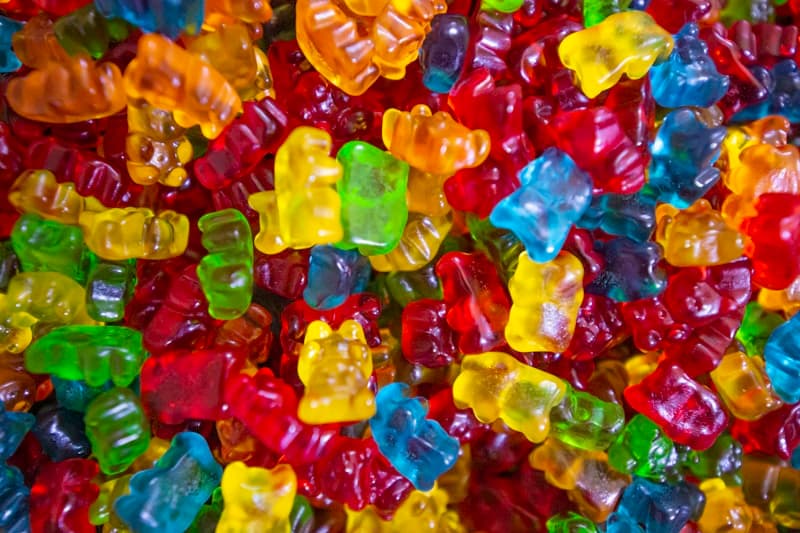
Swedish candy is a category, not a single sweet. It covers gummies, marshmallow shapes, foam candy, chocolate, hard sweets, sour belts, and several varieties of licorice — sweet, mild salt, and full salmiak. What ties it together is texture and flavour density. Swedish candy tends to be chewier, sourer, saltier, and stranger than American or British equivalents. There is more licorice. There are more textures inside a single piece. There is a willingness to combine flavours that would be illegal elsewhere, like salt licorice with raspberry, or fish-shaped foam candy dusted with sour sugar.
Most Swedish candy is bought as lösgodis: loose candy, by weight, from open bins. A normal Swedish grocery store carries 60 to 100 different kinds. You take a paper bag, a small plastic scoop, and you build your own mix.
Why does Sweden eat so much candy?
The short version: a public-health campaign accidentally created a national habit.
The longer version starts in the 1930s, when Swedish dentists discovered that 83% of three-year-olds in Sweden had cavities. The state wanted to know why. In 1945 it funded a study at Vipeholm Hospital, a psychiatric institution near the city of Lund, where patients with intellectual disabilities were given large quantities of sticky sweets at different times of day. The methods were grim and the consent was non-existent — the experiments are still discussed in Sweden as a serious ethical failure. The results, though, were clear: sugar eaten frequently throughout the day caused far more cavities than the same amount of sugar eaten in one sitting.
By the late 1950s, Swedish health authorities had translated that into a public message: eat all the candy you want, but only on Saturdays. Schools and parents picked it up. Radio shows reinforced it. Within a generation it stopped being a recommendation and started being a tradition. That is lördagsgodis.
What is lördagsgodis?
Lördagsgodis (pronounced roughly "LERR-dahs-goo-diss") means Saturday candy. It is the practice of saving all candy eating for Saturday, usually the afternoon or evening, often as part of a family ritual that includes a movie, a TV show, or just sitting on the floor with paper bags of pick-and-mix.
It is loose, not codified. Some families eat candy on other days. Some adults ignore it entirely. But for most Swedes who grew up after the 1960s, Saturday is the candy day, and it carries the emotional weight of a small weekly holiday. Kids in supermarkets on Saturday morning take it seriously. The selection is a project. The bag is engineered.
The tradition has spread to Norway as lørdagsgodis and is now well known in candy-curious circles globally, partly thanks to TikTok creators discovering Swedish pick-and-mix and treating it as a revelation. (We wrote about the full history of Saturday candy in a separate post on lördagsgodis.)
What is salty licorice (salmiak)?
Salty licorice is licorice flavoured with ammonium chloride, a salt that tastes sharp, bitter, slightly metallic, and unlike anything in the standard sweet vocabulary. The Swedish term is salt lakrits. The Finnish word salmiakki is also commonly used, and the chemical itself is often called salmiak in English.
It is the most polarising candy in existence. Non-Nordic visitors usually react with confusion, then mild horror. Nordic eaters consume it casually. The strongest versions — Djungelvrål, Tyrkisk Peber Hot & Sour, Skipper's Pipe — are dosed with enough salmiak to make outsiders cough.
If you've never tried it, do not start with the strong stuff. Start with mild sweet licorice (sweet lakrits), move to mildly salted, then try a salmiak-coated chocolate before going near the powdered industrial ones. For a full breakdown of where to start and what to avoid, read our salty licorice beginner's guide.
What are the most popular Swedish candies?
Among Swedes themselves, the recurring favourites are:
Ahlgrens Bilar — small marshmallow cars in pink, white, and brown. Launched in 1953. Sweden's best-selling candy for over seventy years.
Marabou Mjölkchoklad — the flagship Swedish milk chocolate bar.
Daim — chocolate-coated almond brittle, originally Swedish, now sold worldwide.
Polly — chocolate-covered foam candy from Cloetta, a Saturday standard.
Geléhallon — large gummy raspberries, soft, sugared, slightly tart. The single most recognisable lösgodis shape.
Djungelvrål — extremely salty licorice. Mostly eaten as a dare.
Skumkantareller — pink-and-white foam mushrooms. Childhood-coded.
Polkagris — peppermint sticks from the town of Gränna, hand-pulled since 1859.
Fazer Marianne — peppermint candy with a chocolate centre. Finnish origin, but eaten everywhere in Sweden.
S-märke surt — sour Swedish lollipops in raspberry, pineapple, and lemon.
A Swedish pick-and-mix bag tends to be six to twelve of these, mixed across textures and flavour categories, with at least one piece of licorice and at least one piece of chocolate. If you want a guided starter selection, our beginner's guide to Swedish candy walks through what to pick first.
How does Swedish pick-and-mix (lösgodis) work?
Pick-and-mix in Sweden is closer to a self-serve restaurant than a candy aisle. A typical lösgodis wall has 60–100 transparent bins, each labelled with the name of the candy, the ingredients, and sometimes the country of origin. There is a paper bag dispenser, a stack of small scoops, and a scale.
You take a bag, fill it with whatever you want in any proportion, weigh it at a self-service scale or at the counter, and pay by the kilo. Prices in Sweden are usually 10–14 SEK per 100 grams (roughly $1 USD per 100g).
Outside Sweden, the same model is rare. Most countries that import Swedish candy sell it pre-packaged. A small group of Swedish studios ship the lösgodis experience itself: you build a custom box, pick the exact candies and quantities, and a packer in Sweden assembles it and sends it. Kandy Lover operates this model out of Gothenburg, with real-time weight tracking as you build the box.
When did Swedish candy go viral globally?
Swedish candy started trending on TikTok in late 2023 and accelerated through 2024 and 2025. The format was always the same: a creator unboxes a haul of geléhallon, sour belts, salty licorice, and chocolate-foam candy, films the texture in close-up, and reacts. The reaction is what carried it — Swedish candy has more interesting physical behaviour than most other categories. Foam candies compress and rebound. Chocolate-coated marshmallows pull apart in layers. Sour belts visibly sparkle.
Bubs, one of the larger Swedish candy producers, publicly announced production-capacity investments in 2024 to keep up with TikTok-driven demand. Several US and Australian retailers began stocking Swedish candy for the first time that year. By 2025, "Swedish candy" was a top-ten food search trend on TikTok in multiple English-speaking markets.
Where to buy Swedish candy outside Sweden
Three options, in roughly increasing order of cost and quality:
A local Scandinavian grocery store. Some major cities have one. Selection is usually narrow, and the candy may be older than ideal — Swedish gummies dry out within a few months of leaving Sweden if stored poorly.
An online pre-packaged Swedish candy retailer. Fast to order, usually limited variety. Fine for one-off curiosity.
A custom pick-and-mix studio that ships from Sweden. The closest replica of the lösgodis experience outside Sweden. You choose the exact candies and quantities, and a packer in Sweden assembles the box. Kandy Lover, based in Gothenburg, ships custom boxes worldwide.
If you've never had Swedish candy, the right starting point is a mixed box with at least one sour gummy, one foam candy, one chocolate, one piece of mild licorice, and a small piece of stronger salted licorice. That covers the four flavour territories Swedish candy occupies, in the proportions a Swede would put together on a Saturday.
→ Build your own custom box


